Investigation of Mechanical Performance of Carbon Fiber Powder-Reinforced Composites through SLA-Based Additive Manufacturing
Md. Rubel Miah, Sovon Das, Rotan Kumar Saha, Md. Kamal Hossen, Md. Polash Mia
·
https://doi.org/10.63414/jeas.v.10.n2.2026.122
Abstract
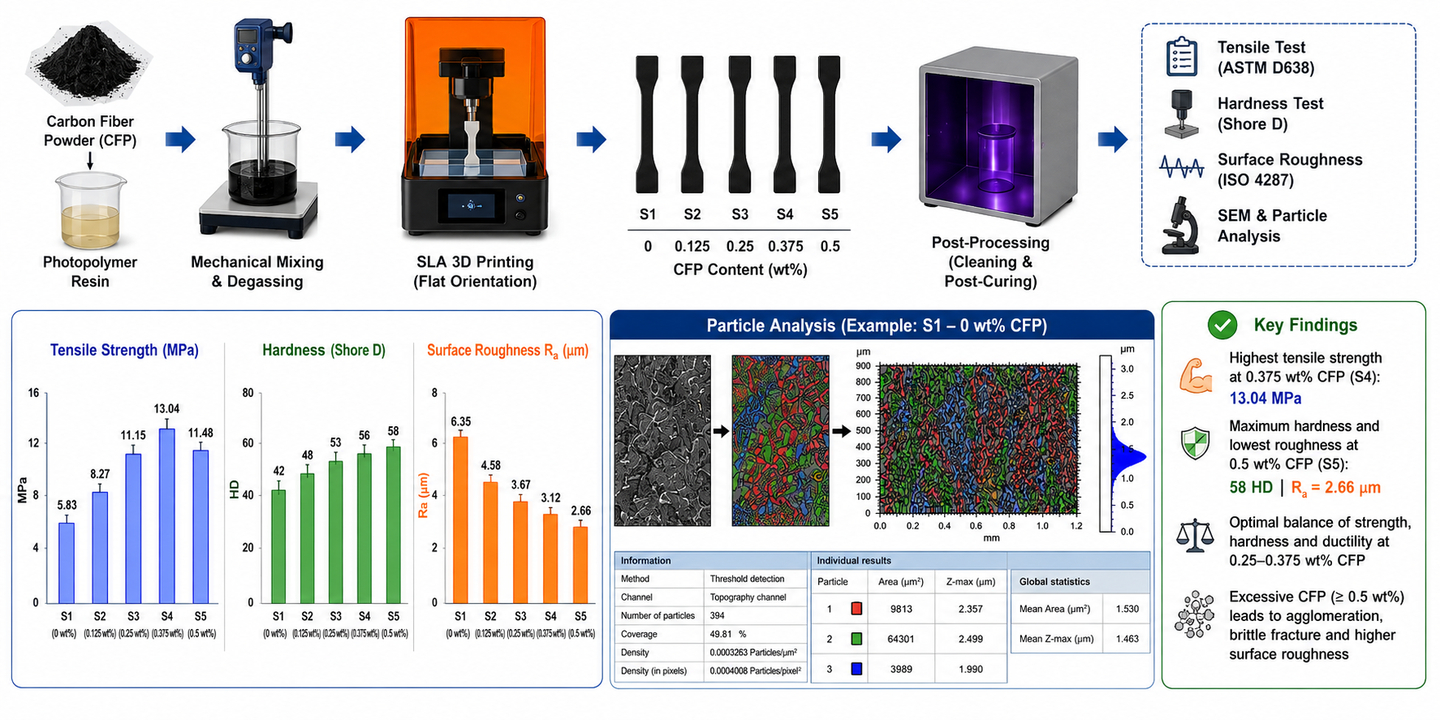
This study investigates the mechanical performance of carbon fiber powder (CFP)-reinforced photopolymer composites fabricated through stereolithography (SLA)-based additive manufacturing. Composite specimens containing 0-0.5 wt% CFP were fabricated and evaluated through tensile, hardness, surface roughness, SEM and particle analyses. The incorporation of CPF significantly improved the mechanical properties of the printed composites. The highest tensile strength of 13.04 MPa was achieved at 0.375 wt% CFP loading (S4), representing a substantial improvement over the neat resin specimen (5.83 MPa). Maximum hardness (58 HD) and the lowest surface roughness (Ra = 2.66 μm) were obtained at 0.5 wt% CFP content (S5). SEM and particle analyses revealed that excessive reinforcement promoted brittle fracture characteristics, internal cracking and increased surface irregularities. Overall, CFP contents between 0.25 and 0.375 wt% provided the best balance between strength, hardness and ductility. These findings demonstrate the potential of SLA-fabricated CFP composites for lightweight engineering and functional structural applications.
Conclusion
This study systematically investigated the effect of CFP concentration on the mechanical, surface and microstructural behavior of SLA 3D-printed photopolymer composites. The results demonstrated that CFP content plays a critical role in governing the balance between strength enhancement and structural integrity. Tensile analysis revealed that an intermediate reinforcement range of 0.125-0.25 wt% (S2-S3) provides the most balanced performance, achieving tensile strength of 10.28-11.82 MPa and higher ductility of 14.34-16.57%, along with maximum load capacity up to 565.72 N. In contrast, higher CFP loadings (S4-S5) increased tensile strength up to 13.04 MPa but resulted in reduced strain (9.71-12.41%), indicating increased brittleness and reduced plastic deformation capability. Hardness results showed a continuous improvement with increasing CFP content, rising from 47.50 HD (S1) to 58.00 HD (S5), confirming enhanced surface resistance due to reinforcement effects. Surface roughness analysis indicated a non-linear trend, where the highest fiber loading (S5) achieved the lowest Ra value (2.66 μm), suggesting improved surface smoothness; however this was accompanied by evidence of subsurface structural damage. SEM and particle analysis further confirmed that low reinforcement levels promote uniform particle distribution and stable microstructure, whereas higher CFP concentrations induce microvoids, uneven layer formation, brittle fracture features and internal cracking. Notably, S1 exhibited homogeneous particle dispersion, while S5 showed elevated particle density and maximum Z-max values (287.8 nm), indicating significant subsurface defects. Overall, the optimal CFP content range of 0.125-0.25 wt% ensures superior mechanical integrity, balanced ductility and acceptable surface quality due to effective stress transfer and uniform dispersion. Higher loading levels, although improving hardness and apparent surface finish, compromise structural reliability due to defect formation and interfacial weakness. Future research should focus on real-time process monitoring, fatigue and durability assessment, hybrid reinforcement strategies and multiscale modeling approaches to further enhance the reliability of SLA-fabricated fiber-reinforced composites for advanced engineering applications in automotive and biomedical sectors.
References
[2]
A. Husna, S. Ashrafi, A. A. Tomal, N. T. Tuli, and A. B. Rashid, “Recent advancements in stereolithography (SLA) and their optimization of process parameters for sustainable manufacturing,” Hybrid Advances, vol. 7, p. 100307, Oct. 2024, doi
https://doi.org/10.1016/j.hybadv.2024.100307
[3]
J. Wong, A. Altassan, and D. W. Rosen, <em>“Additive manufacturing of fiber-reinforced polymer composites: A technical review and status of design methodologies</em>,” Composites Part B Engineering, vol. 255, p. 110603, Feb. 2023, doi
https://doi.org/10.1016/j.compositesb.2023.110603
[4]
B. Pszczółkowski and M. Zaborowska, “Effect of layer exposure time in SLA-LCD printing on surface topography, hardness and chemical structure of UV-Cured photopolymer,” Lubricants, vol. 13, no. 9, p. 406, Sep. 2025, doi
https://doi.org/10.3390/lubricants13090406
[5]
E. Hozdić, <em>“Characterization and comparative analysis of mechanical parameters of FDM- and SLA-Printed ABS materials</em>,” Applied Sciences, vol. 14, no. 2, p. 649, Jan. 2024, doi
https://doi.org/10.3390/app14020649
[6]
P. Jirků et al., “Evaluation of mechanical properties and filler interaction in the field of SLA Polymeric Additive manufacturing, <em>” Materials</em>, vol. 16, no. 14, p. 4955, Jul. 2023, doi
https://doi.org/10.3390/ma16144955
[7]
C. Yang, K. Wang, J. Zhang, and A. Codolini, “Additive manufacturing of Fibre-Reinforced polymer composites,” Polymers, vol. 17, no. 12, p. 1652, Jun. 2025, doi
https://doi.org/10.3390/polym17121652
[8]
T. Gao et al., <em>“Study on the reinforcement mechanism of LCD photopolymerization 3D-printed triply periodic minimal surface structures doped with carbon fiber and hydroxyapatite</em>,” Polymer Testing, vol. 156, p. 109134, Feb. 2026, doi
https://doi.org/10.1016/j.polymertesting.2026.109134
[9]
K. Rithika and J. Sudha, “Additive Manufacturing of Fiber‐Reinforced Composites—A Comprehensive Overview,” Polymers for Advanced Technologies, vol. 35, no. 12, Dec. 2024, doi
https://doi.org/10.1002/pat.70002
[10]
R. Xiao, M. Ding, Y. Wang, L. Gao, R. Fan, and Y. Lu, “Stereolithography (SLA) 3D printing of carbon fiber-graphene oxide (CF-GO) reinforced polymer lattices, <em>” Nanotechnology</em>, vol. 32, no. 23, p. 235702, Feb. 2021, doi
https://doi.org/10.1088/1361-6528/abe825
[11]
M. Ramesh, K. Niranjana, R. Bhoopathi, and L. Rajeshkumar, <em>“Additive manufacturing (3D printing) technologies for fiber-reinforced polymer composite materials: A review on fabrication methods and process parameters</em>,” e-Polymers, vol. 24, no. 1, Jan. 2024, doi
https://doi.org/10.1515/epoly-2023-0114
[12]
R. Wagmare, R. Harshe, J. Pednekar, and T. U. Patro, “Additive manufacturing of continuous fiber-reinforced polymer composites: current trend and future directions,” Progress in Additive Manufacturing, vol. 10, no. 4, pp. 1973–2000, Sep. 2024, doi
https://doi.org/10.1007/s40964-024-00777-9
[13]
M. M. Rahman et al., “Polymer composites in Additive Manufacturing: Current technologies, applications, and emerging trends,” Polymers, vol. 18, no. 2, p. 192, Jan. 2026, doi
https://doi.org/10.3390/polym18020192
[14]
C. Thomas and A. H. Sakhaei, “Additive manufacturing of continuous fibre reinforced composites: process, characterisation, modelling, and sustainability, <em>” Advanced Engineering Materials</em>, Apr. 2026, doi
https://doi.org/10.1002/adem.202503048
[15]
R. M. Salih, A. Kadauw, H. Zeidler, and R. Aliyev, “Investigation of LCD 3D printing of carbon fiber composites by utilising central composite design, <em>” Journal of Manufacturing and Materials Processing</em>, vol. 7, no. 2, p. 58, Mar. 2023, doi
https://doi.org/10.3390/jmmp7020058
[16]
G. Taormina, C. Sciancalepore, M. Messori, and F. Bondioli, <em>“3D printing processes for photocurable polymeric materials: technologies</em>, materials, and future trends, <em>” Journal of Applied Biomaterials & Functional Materials</em>, vol. 16, no. 3, pp. 151–160, Apr. 2018, doi
https://doi.org/10.1177/2280800018764770
[17]
F. Tamburrino, B. Aruanno, A. Paoli, A. V. Razionale, and S. Barone, “Design and effect of a resin infiltration method to enhance the interlayer adhesion of additively manufactured PEEK parts,” Polymers, vol. 17, no. 21, p. 2819, Oct. 2025, doi
https://doi.org/10.3390/polym17212819
[18]
J. Yan et al., “Improving mechanical and tribological properties of carbon fabric/resin laminated composites by carbon fiber powder,” Polymer Composites, vol. 45, no. 5, pp. 4389–4400, Feb. 2024, doi
https://doi.org/10.1002/pc.28068
[19]
W. T. Nugroho, D. A. Tyagita, A. Wahyudiono, and D. D. Suranto, <em>“DIMENSIONAL ACCURACY OF 3D PRINTED DOG BONE STRUCTURES</em>,” DOAJ (DOAJ: Directory of Open Access Journals), Aug. 2025, doi
https://doi.org/10.21776/jrm.v16i2.2158