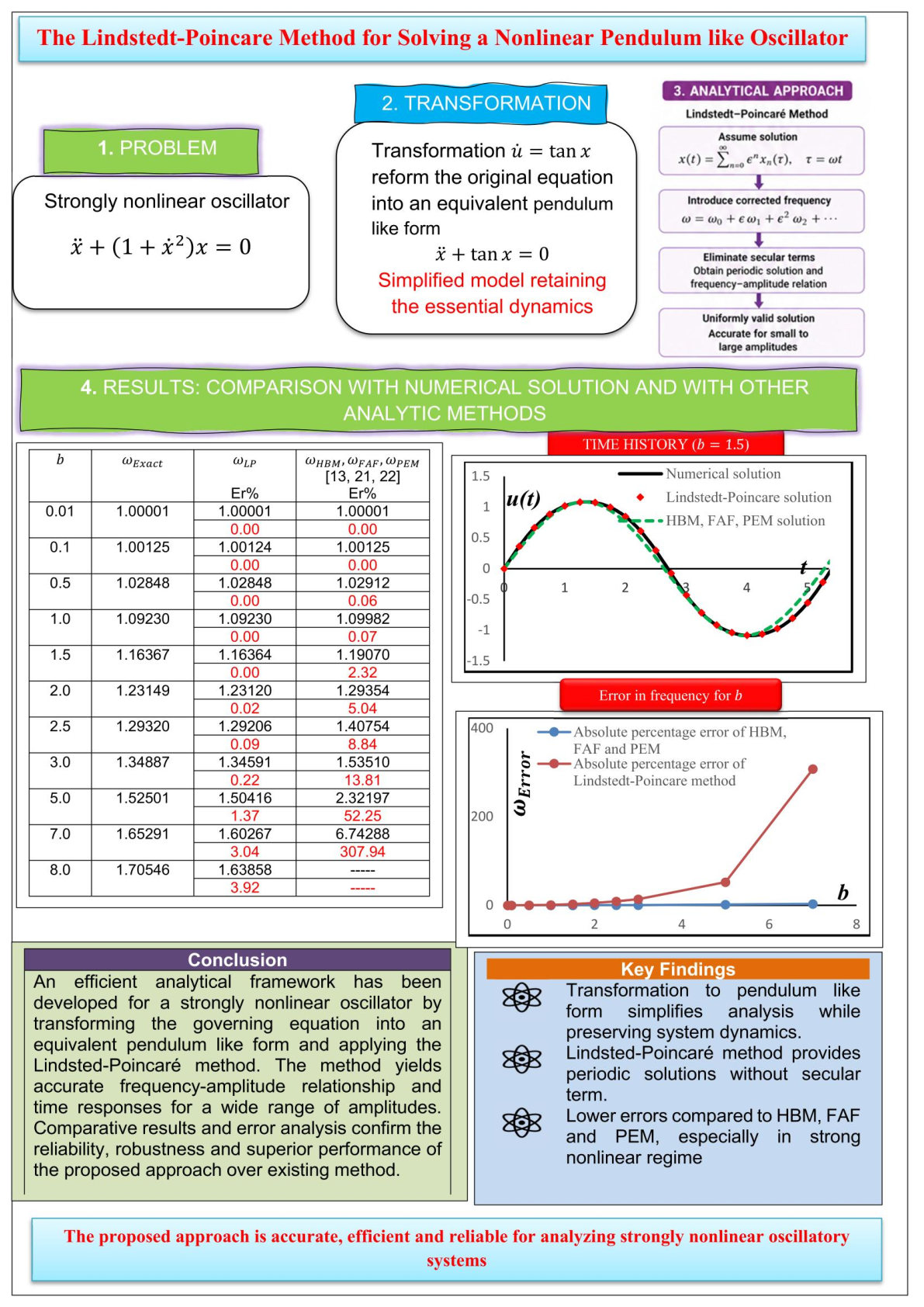
The periodically addressed steady-state response of a nonlinear pendulum like oscillator is investigated in this study using the classical Lindstedt–Poincare technique. The oscillator is obtained by a systematic transformation of the nonlinear differential equation u ̈+(1+u ̇^2 )u=0, which cannot be easily handled in its original form because of its high nonlinearity. The system can be simplified to a corresponding pendulum like nonlinear oscillator of the form x ̈+tanx=0, along with consistently transformed initial conditions. This change does not alter any of the basic dynamical characteristics, but drastically simplifies the analytical treatment. Nonlinear oscillatory systems are common in physics and engineering, and the equations governing their behavior do not often have analytical solutions. Many traditional perturbation techniques can give secular terms that are increasing with time, and provide non-uniform and physically unrealistic approximations. In order to solve this problem, the Lindstedt-Poincare method is used to remove the secular terms by adding a perturbation expansion to the system frequency, and this ensures the uniformly valid periodic solutions. The Lindstedt-Poincare method is used to compute approximate analytical expressions of the solution and frequency of the transformed oscillator. The accuracy and effectiveness of the proposed approach are demonstrated through comparisons with numerical solutions obtained by the fourth-order Runge–Kutta method, as well as with results from the harmonic balance method, frequency–amplitude formulation, and the parameter expansion method. The comparisons show excellent agreement, confirming the reliability and robustness of the present analysis for nonlinear oscillatory systems.
This paper has provided an analytical framework of studying a highly nonlinear oscillatory system by rewriting the original governing equation into a corresponding pendulum like equation. This work simplifies the mathematical treatment of the system and still retains the basic dynamical properties of the system which allows the application of classical analytical methods. Lindstedt-Poincare method successfully has been used to obtain approximate periodic solutions and the corresponding frequency-amplitude relationships. The approach removes the secular terms, and provides uniformly sound solutions over long durations of time. This characteristic renders it especially useful in the analysis of nonlinear oscillators with the amplitude-dependent behavior.
The validity and strength of the proposed method have been rigorously tested by comparing the results with numerical solutions to systems found using the fourth-order Runge-Kutta method, as well as with the results of other established analytic techniques, such as the harmonic balance technique, frequency-amplitude technique, and parameter expansion technique. The findings indicate that there is an excellent agreement of small and high amplitudes, and that the current method is significantly more accurate than the compared methods at higher amplitudes. Specifically, even in the highly nonlinear regime, the error growth is relatively small, which evidently demonstrates the reliability and stability of the approach.
In general, the current analysis proves that the combination of an appropriate transformation and the Lindstedt-Poincare method is a potent and effective tool to investigate nonlinear oscillatory systems. The methodology that has been developed in this work can be applied to a wider range of nonlinear problems that can be used to provide valuable insights into the dynamic behavior and frequency characteristics of these types of nonlinear problems.
Conflict of Interest
No conflict-of-interest present among the authors.
Data Availability
No datasets were generated or analyzed during the current study.
Funding Statement
The authors declare that no funds, grants, or other support were received during the preparation of this manuscript.
[1]
H. Nayfeh, Perturbation Methods, John Wiley & Sons, New York, 1973. A Lindstedt, “Über die integration einer für die störungstheorie wichtigen differentialgleichung”, Astronomische Nachrichten, Vol. 103, pp. 211-220, 1882. Poincare H, New methods of Celestial Mechanics, Vol. I-III, 1892. Y. K. Cheung, S. H. Chen and S. L. Lau, “A modified Lindstedt-Poincare method for certain strongly non-linear oscillators”, <em>International Journal of Nonlinear Mechanics</em>, Vol. 26(3), pp. 367-378, 1991. M. S. Alam, I. A. Yeasmin and M. S. Ahamed, “Generalization of the modified Lindstedt-Poincare method for solving some strong nonlinear oscillators”, <em>Ain Shams Engineering Journal</em>, Vol. 10, pp.195–201, 2019. M. S. Alam, M. N. Sharif and M. H. U. Molla, “Combination of modified Lindstedt-Poincare and homotopy perturbation methods”, <em>Journal of Low Frequency Noise</em>, Vibration and Active Control, Vol. 42, no. 2, pp. 642-653, 2023. M. N. Sharif, M. S. Alam and I. A. Yeasmin, “Faster convergent modified Lindstedt-Poincare solution of nonlinear oscillators”, <em>Universal Journal of Mathematics and Applications</em>, pp. 53-60, 2023. M. Z. Alam, M. A. Hosen and M. S. Alam, “A new modified Lindstedt-Poincare method for nonlinear damped forced oscillations”, Results in Physics, Vol. 51, 2025. I. A. Yeasmin, M. S. Rahman and M. S. Alam, “The modified Lindstedt–Poincare method for solving quadratic nonlinear oscillators”, <em>Journal of Low Frequency Noise</em>, Vibration and Active Control, Vol. 40, 2020. R. E. Mickens, “A generalization of the method of harmonic balance”, <em>Journal of Sound and Vibration</em>, Vol. 111, pp. 515-518, 1986. M. H. U. Molla, M. A. Razzak and M. S. Alam, <em>“Harmonic balance method for solving a large-amplitude oscillation of a conservative system with inertia and static non-linearity”</em>, Results in Physics, Vol. 6, pp. 238-242, 2016. M. N. Sharif and I. A. Yeasmin, “A Comparative study of the pendulum equation using two analytical methods”, <em>Journal of Mathematics</em>, Vol. 2024, 9107226, 12 pages, 2024. A. Chatterjee, “Harmonic balance based averaging: approximate realizations of an asymptotic technique,” Nonlinear Dynamics, vol. 32, no. 4, pp. 323-343, 2003. J. H. He, “Variational iteration method: a kind of nonlinear analytic technique: some examples”, <em>International Journal Non-Linear Mechanics</em>, Vol. 34, pp. 699–708, 1999. R. E. Mickens, “Iteration procedure for determining approximate solutions to nonlinear oscillator equation”, <em>Journal of Sound and Vibration</em>, Vol. 116, pp.185–8, 1987. M. I. Haque, M. S. Alam and M. M. Rahman, “Modified solutions of some oscillators by iteration procedure”, <em>Journal of the Egyptian Mathematical Society</em>, Vol. 21, pp. 68–73, 2013. J. H. He, “Homotopy perturbation technique”, <em>Computer methods in applied mechanics and engineering</em>, vol. 178, no. 3-4, pp. 257-262, 1999. N. Sharif, H. U. Molla and M. S. Alam, <em>“Analytical solution of couple-mass-spring systems by novel homotopy perturbation method”</em>, International Journal of Non-Linear Mechanics, vol. 167, 2024, doi: . J. H. He, “Preliminary report on the energy balance for nonlinear oscillations”, <em>Mechanics Research Communications</em>, vol. 29, no. 2-3, pp. 107-111, 2002. M. H. U. Molla and N. Sharif, “Energy balance method for solving nonlinear oscillators with non-rational restoring force”, <em>Applied Mathematical Sciences</em>, vol. 17, no. 14, pp. 689-700, 2023, doi: 10.12988/ams.2023.918530. G.-h. Chen, Z.-L. Tao, and J.-Z. Min, “Notes on a conservative nonlinear oscillator,” Computers & Mathematics with Applications, vol. 61, no. 8, pp. 2120-2122, 2011, doi: 10.1016/j.camwa.2010.08.086. L. Xu, “He's parameter-expanding methods for strongly nonlinear oscillators, <em>” Journal of Computational and Applied Mathematics</em>, vol. 207, no. 1, pp. 148-154, 2007, doi: 10.1016/j.cam.2006.07.020. G. Veronis, “A note on the method of multiple time-scales”, Quarterly of Applied Mathematics, 38, 363–368, 1980. T. D. Burton, “A perturbation method for certain nonlinear oscillators”, <em>International Journal of Nonlinear Mechanics</em>, 19, 397-407, 1984. T. D. Burton and Z. Rahman,” On the multi-scale analysis of strongly non-linear forced oscillators”, <em>International Journal of Nonlinear Mechanics</em>, 21, 135-146, 1986. J. Beatty and R. E. Mickens,” A qualitative study of the solutions to the differential equation x ̈+(1+x ̇^2 )x=0”, <em>Journal of Sound and Vibration</em>, 283, 475–477, 2005
https://doi.org/10.1016/j.ijnonlinmec.2024.104923