A Comparative Study on the Effect of Coconut Coir, Steel and Hybrid Fiber Length on the Mechanical Properties of Concrete
Mehedi Hasan, Trishna Pandit Toma, Nusaiba Binte Mamun, Moriam Emran Mridula, Md. Sofiullah Shihab
·
https://doi.org/10.63414/jeas.v.10.n1.2026.117
Abstract
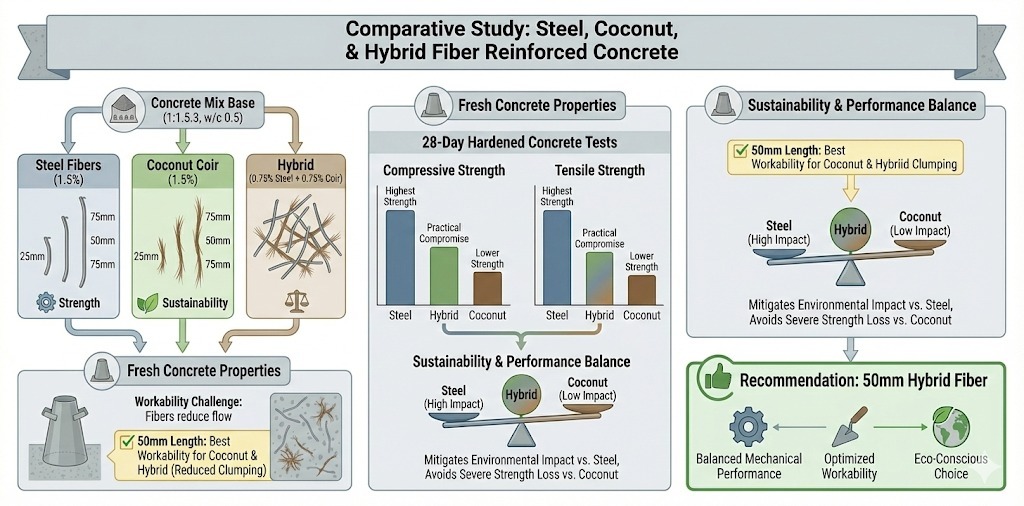
Although fiber reinforcement is popular for enhancing concrete's durability and cost-effectiveness, there is limited data on how natural and artificial fibers behave when used together in one mixture. This paper addresses that gap by comparing the mechanical effects of steel fibers, coconut coir and a hybrid combination of both. We prepared specimens using fiber lengths of 25 mm, 50 mm, and 75 mm, keeping a constant fiber content of 1.5% within a 1:1.5:3 concrete mix using a water-to-cement ratio of 0.5. For the hybrid batches, we specifically combined 0.75% steel and 0.75% coconut coir to see if we could effectively balance structural strength with sustainability.
The tests on fresh concrete showed that while adding fibers generally makes the mix harder to work with, the 50 mm length offered the best workability for the coconut and hybrid batches, avoiding the clumping issues often seen with shorter fibers. The 28 days tests confirmed that steel fibers naturally provide the biggest boost to compressive and tensile strength. That said, the hybrid samples offered a practical compromise. They were stronger than the plain coconut coir mixes and provide a more sustainable option than using steel alone. We found that the hybrid mix helps mitigate the environmental impact of steel while avoiding the severe strength loss often seen with natural fibers. When we balanced mechanical performance against workability and environmental concerns, the, 50 mm hybrid fiber stood out as the most effective choice for construction.
Conclusion
The behaviour of steel fiber, coconut coir fiber, and coconut coir-steel (hybrid) fiber reinforced concrete has been studied in this research, to be able to ascertain and compare the impact of variation in length of various fiber types on the mechanical properties of concrete. Particularly, the compression strength and splitting tensile strength were tested and compared with standard concrete.
The following conclusions can be made regarding the findings of this investigation:
1) Incorporation of fiber in concrete significantly decreases the slump value for all fiber types and lengths. The maximum reduction was observed for the addition of coconut coir fiber, that decrease the slump value up to 66.67% compared to CS. Steel fiber showed better performance than other fibers showing a minimum reduction of 18.18% and the slump value of HFRC was between SFRC and CFRC showing a reduction of 36.36% in respect to CS.
2) The variation of fiber length had a considerable effect on the slump value. For steel fibers slump value increased with increasing length of fiber. However, for coconut coir fiber the slump improved at first and subsequently deteriorated as the fiber length was increased from 25 to 75 mm. The hybrid fiber showed similar results to CFRC. In all cases, 50 mm fiber length showed the most optimum slump value except for steel fiber, for which the optimum length was 75 mm.
3) Addition of fiber showed a decreasing trend for 7 day’s compressive strength, but subsequently increased compressive strength was observed after 28 days. The addition of steel fiber showed a maximum increase in compressive strength which was 20.18%. Improvement for coconut coir and hybrid fiber was significantly lower than that of steel fiber with a maximum increase of 3.46% and 6.13%, respectively.
4) In every instance, adding fiber first enhanced compressive strength before decreasing it as fiber length climbed from 25 to 75 mm. Fiber length of 50 mm showed the optimum compressive strength for all kinds of fibers.
5) Fiber incorporation showed a significant increasing trend for both 7 day’s and 28 day’s splitting tensile strength. Compared to other fiber types addition of steel fiber showed the maximum enhancement in splitting tensile strength, increasing the strength up to 20.53% after 28 days. CFRC and HFRC showed maximum improvement of 3.16% and 8.42%, respectively, after 28 days, which is significantly lower than that of SFRC.
6) For all concrete mixes, fiber incorporation increased the splitting tensile strength as the fiber length increased from 25 mm to 75 mm. Fiber length of 75 mm showed the maximum splitting tensile strength for all types of fibers.
7) For all types and lengths of fibers, 50 mm fiber length showed the most optimum results considering all three parameters. Steel fiber exhibits the greatest effectiveness in increasing compressive and tensile strength. Coconut coir fiber showed the lowest improvement. Nonetheless, the addition of 50 mm hybrid fiber can be considered the most optimal from a sustainable point of view.
References
[1]
Wang, X., He, J., Mosallam, A.S., Li, C., Xin, H., <em>and Engineering</em>, The effects of fiber length and volume on material properties and crack resistance of basalt fiber reinforced concrete (BFRC). Advances in Materials Science, 2019. 2019: p. 1-17.
[2]
Islam, A., Shuvo, A.K., Chowdhury, S.A., Sharmin, S., and Hasan, M., A comparative study on the properties of natural, <em>synthetic and steel fibre reinforced concrete. Journal of Civil Engineering Construction</em>, 2021. 10(4): p. 216-224.
[3]
Islam, S.M., Hussain, R.R., and Morshed, M.A.Z., <em>Fiber-reinforced concrete incorporating locally available natural fibers in normal-and high-strength concrete and a performance analysis with steel fiber-reinforced composite concrete. Journal of composite materials</em>, 2012. 46(1): p. 111-122.
[4]
Das, S., Sobuz, M.H.R., Tam, V.W., Akid, A.S.M., Sutan, N.M., and Rahman, F.M., <em>Effects of incorporating hybrid fibres on rheological and mechanical properties of fibre reinforced concrete. Construction Building Materials</em>, 2020. 262: p. 120561.
[5]
Han, J., Zhao, M., Chen, J., and Lan, X., <em>Effects of steel fiber length and coarse aggregate maximum size on mechanical properties of steel fiber reinforced concrete. Construction Building Materials</em>, 2019. 209: p. 577-591.
[6]
W. K. Biswas, X. Zhang, C. Matters, and M. Maboud, “Techno-Eco-Efficiency Assessment of Using Recycled Steel Fibre in Concrete,” Sustainability, vol. 16, no. 9, p. 3717, Apr. 2024, doi
https://doi.org/10.3390/su16093717
[7]
Mahmud, S., Hasan, K.F., Jahid, M.A., Mohiuddin, K., Zhang, R., and Zhu, J., <em>Comprehensive revion plant fiber-reinforced polymeric biocomposites. Journal of Materials Science</em>, 2021. 56: p. 7231-7264.
[8]
Memon, M.J., Jhatial, A.A., Murtaza, A., Raza, M.S., and Phulpoto, K.B., <em>Production of eco-friendly concrete incorporating rice husk ash and polypropylene fibres. Environmental Science Pollution Research</em>, 2021. 28: p. 39168-39184.
[9]
Olivito, R.S., Cevallos, O., and Carrozzini, A., <em>Development of durable cementitious composites using sisal and flax fabrics for reinforcement of masonry structures. Materials Design</em>, 2014. 57: p. 258-268.
[10]
Jamshaid, H., Mishra, R.K., Raza, A., Hussain, U., Rahman, M.L., Nazari, S., Chandan, V., Muller, M., and Choteborsky, R., <em>Natural cellulosic fiber reinforced concrete: influence of fiber type and loading percentage on mechanical and water absorption performance. Materials</em>, 2022. 15(3): p. 874.
[11]
Bourmaud, A. and Baley, C., <em>Nanoindentation contribution to mechanical characterization of vegetal fibers. Composites Part B: Engineering</em>, 2012. 43(7): p. 2861-2866.
[12]
Chandramohan, D. and Marimuthu, K., <em>A review on natural fibers. International Journal of Research Reviews in Applied Sciences</em>, 2011. 8(2): p. 194-206.
[13]
Shih, Y.-F., Cai, J.-X., Kuan, C.-S., and Hsieh, C.-F., <em>Plant fibers and wasted fiber/epoxy green composites. Composites Part B: Engineering</em>, 2012. 43(7): p. 2817-2821.
[14]
Ali, M., Liu, A., Sou, H., and Chouw, N., <em>Mechanical and dynamic properties of coconut fibre reinforced concrete. Construction Building Materials</em>, 2012. 30: p. 814-825.
[15]
M. Nissar, C. K. N., Y. A. Birjerane, S. Patil, S. Shetty, and A. Das, <em>“Coconut Coir Fiber Composites for Sustainable Architecture: A Comprehensive Review of Properties</em>, Processing, and Applications,” J. Compos. Sci., vol. 9, no. 10, p. 516, Sept. 2025, doi
https://doi.org/10.3390/jcs9100516
[16]
J. Ahmad, M. A. Majdi, A. F. Deifalla, M. Althoey, and M. A. Hussein, <em>“Mechanical and durability performance of coconut fiber reinforced concrete: A state-of-the-art review</em>,” Materials, vol. 15, no. 10, p. 3601, May 2022, doi
https://doi.org/10.3390/ma15103601
[17]
J. Wei and C. Meyer, “Degradation mechanisms of natural fiber in the matrix of cement composites, <em>” Cement and Concrete Research</em>, vol. 73, pp. 1–16, Jul.2015,doi:https://doi.org/
https://doi.org/10.1016/j.cemconres.2015.02.019
[18]
Haseena, A., Dasan, K.P., Unnikrishnan, G., and Thomas, S., <em>Mechanical properties of sisal/coir hybrid fibre reinforced natural rubber. Progress in Rubber Plastics Recycling Technology</em>, 2005. 21(3): p. 155-181.
[19]
Panthapulakkal, S., Raghunanan, L., Sain, M., KC, B., and Tjong, J., Natural fiber and hybrid fiber thermoplastic composites: advancements in lightweighting applications, in Green composites. 2017, Elsevier. p. 39-72.
[20]
Rajak, D.K., Pagar, D.D., Menezes, P.L., and Linul, E., Fiber-reinforced polymer composites: Manufacturing, properties, and applications. Polymers, 2019. 11(10): p. 1667.
[21]
Varghese, A. and Unnikrishnan, S., <em>Mechanical strength of coconut fiber reinforced concrete. Materials Today: Proceedings</em>, 2023.
[22]
Hwang, C.-L., Tran, V.-A., Hong, J.-W., and Hsieh, Y.-C., Effects of short coconut fiber on the mechanical properties, plastic cracking behavior, <em>and impact resistance of cementitious composites. Construction Building Materials</em>, 2016. 127: p. 984-992.
[23]
Andiç-Çakir, Ö., Sarikanat, M., Tüfekçi, H.B., Demirci, C., and Erdoğan, Ü.H., <em>Physical and mechanical properties of randomly oriented coir fiber–cementitious composites. Composites Part B: Engineering</em>, 2014. 61: p. 49-54.
[24]
Lertwattanaruk, P. and Suntijitto, A., <em>Properties of natural fiber cement materials containing coconut coir and oil palm fibers for residential building applications. Construction Building Materials</em>, 2015. 94: p. 664-669.
[25]
Aggarwal, L., Studies on cement-bonded coir fibre boards. Cement Concrete Composites, 1992. 14(1): p. 63-69.
[26]
Blanco, A., Pujadas, P., De la Fuente, A., Cavalaro, S., and Aguado, A., <em>Assessment of the fibre orientation factor in SFRC slabs. Composites Part B: Engineering</em>, 2015. 68: p. 343-354.
[27]
Cavalaro, S.H.P., López, R., Torrents, J.M., and Aguado, A., <em>Improved assessment of fibre content and orientation with inductive method in SFRC. Materials Structures</em>, 2015. 48: p. 1859-1873.
[28]
Mastali, M., Dalvand, A., Sattarifard, A., Abdollahnejad, Z., and Illikainen, M., Characterization and optimization of hardened properties of self-consolidating concrete incorporating recycled steel, industrial steel, <em>polypropylene and hybrid fibers. Composites Part B: Engineering</em>, 2018. 151: p. 186-200.
[29]
Thomas, J. and Ramaswamy, A., <em>Mechanical properties of steel fiber-reinforced concrete. Journal of materials in civil engineering</em>, 2007. 19(5): p. 385-392.
[30]
Song, P. and Hwang, S., <em>Mechanical properties of high-strength steel fiber-reinforced concrete. Construction Building Materials</em>, 2004. 18(9): p. 669-673.
[31]
Standards, A.I.J.A.B.o.A., ASTM C192/C192M-19, Standard Practice for Making and Curing Concrete Test Specimens in the Laboratory. 2019, American Society of Testing Materials.
[32]
ASTM, ASTM C143/C143M-15a, Standard test method for slump of hydraulic-cement concrete. 2015, ASTM International West Conshohocken.
[33]
ASTM, A.J.A.I., West Conshohocken, PA. ASTM, AI ." ASTM C, ASTM C39/C39M-18 standard test method for compressive strength of cylindrical concrete specimens. 2018. 192.
[34]
Standard, A.J.A.I., West Conshohocken PA, C496/C496M-17 Standard test method for splitting tensile strength of cylindrical concrete specimens. 2017.
[35]
Ahmad, W., Farooq, S.H., Usman, M., Khan, M., Ahmad, A., Aslam, F., Yousef, R.A., Abduljabbar, H.A., and Sufian, M., <em>Effect of coconut fiber length and content on properties of high strength concrete. Materials</em>, 2020. 13(5): p. 1075.