Digital Transformation Barriers among Rural Women Entrepreneurs in Selected Rural Areas of Rajshahi and Naogaon Districts, Bangladesh: A Qualitative Study
Abstract
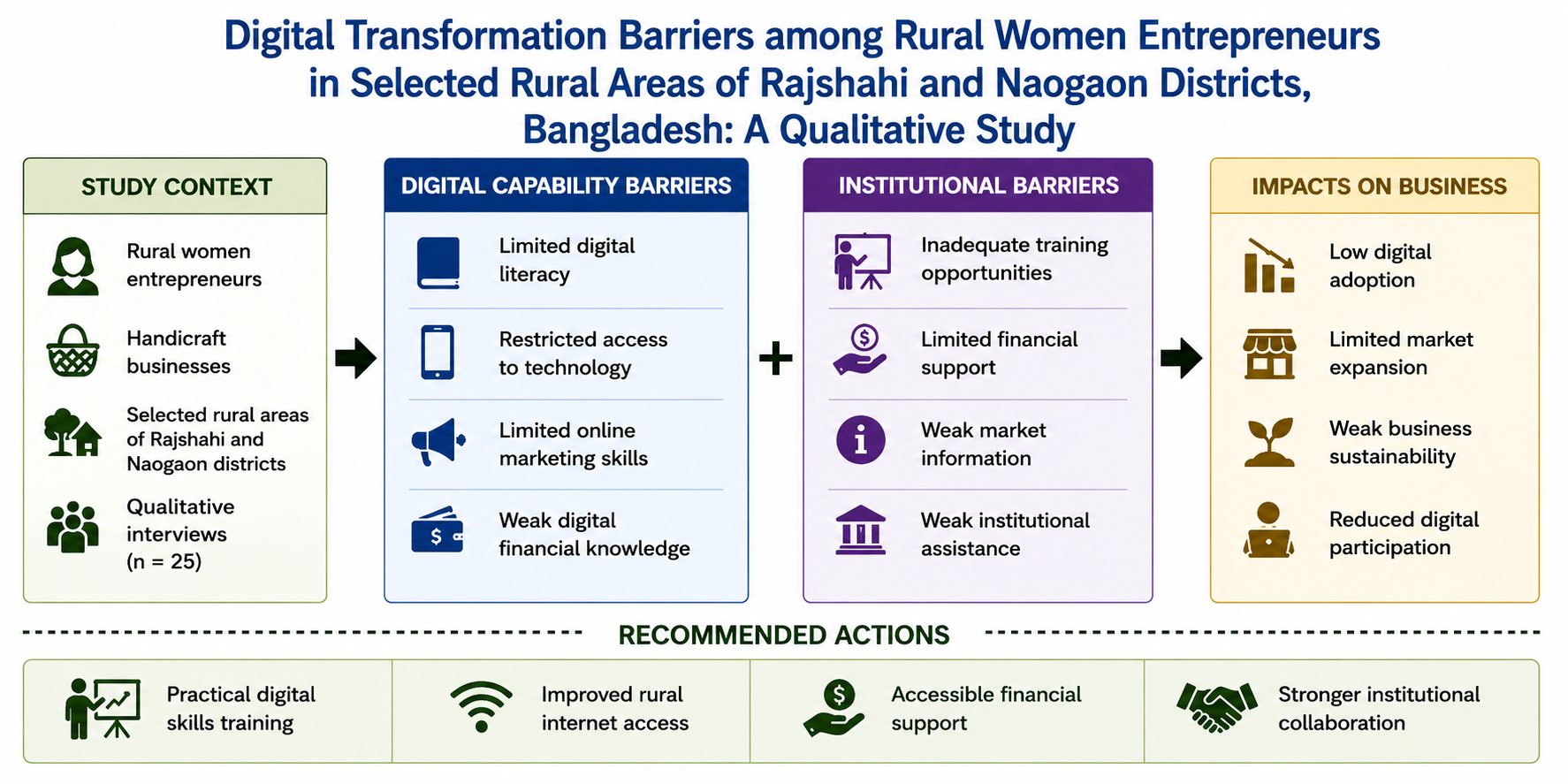
The digital revolution has opened up fresh avenues for small businesses with digital marketing, digital payment systems and social media. Rural women entrepreneurs in Bangladesh are increasingly experimenting to use digital tools to enhance their market access and business sustainability. But many are dealing with major challenges for effective digital adoption. This study aims to understand the problems of digital transformation of rural women handicraft entrepreneurs in Bangladesh. In-depth semi-structured interviews with 25 rural women entrepreneurs were conducted in selected rural areas with the qualitative descriptive approach. Thematic analysis was used to identify the key barriers to digital adoption. The results indicate that digital participation is hindered by limited digital literacy, poor access to technology, poor online marketing skills, and low digital financial knowledge. Also, digital transformation is impeded by institutional barriers like inadequate training opportunities, lack of financial resources, and low institutional support. The study suggests practical digital training, better internet facilities in rural areas and financial assistance to encourage sustainable digital entrepreneurship among rural women in Bangladesh.
Conclusion
The current study examined the obstacles in the digital transformation of women entrepreneurs in the handicraft sector in rural areas of Bangladesh through qualitative interviews with 25 women entrepreneurs from selected rural areas. The findings reveal that the rural women entrepreneurs are very interested in the use of digital technologies for business development, but there are still several capability-related and institutional barriers that hinder their digital participation. The study identified a number of barriers to the use of digital, including a lack of digital literacy, access to technology, digital financial knowledge and online marketing skills. Moreover, digital entrepreneurship among rural women is further hampered by institutional constraints like lack of training opportunities, financial support, market information and institutional support. The results also show that the digital transformation of rural entrepreneurship is not just about access to technology. Institutional environments that are conducive, digital skills that are functional, financial access and improved market connectivity are needed to enable digital adoption. Rural women entrepreneurs will likely remain marginalized from the wider opportunities offered by digital economies if these barriers are not tackled together. The study reveals that if the rural women entrepreneurs are provided with appropriate support systems, they are motivated and willing to adopt digital business practices. Thus, inclusive digital entrepreneurship needs to be fostered through a concerted effort by the government, financial institutions, development organizations, and local support networks.
References
[1]
Afrin, S., Islam, N., & Ahmed, <em>S. U. (2008). A multivariate model of micro credit and rural women entrepreneurship development in Bangladesh. International Journal of Business and Management</em>, 3(8), 169–185.
[2]
Azmat, <em>F. (2013). Opportunities or obstacles? Understanding the challenges faced by migrant women entrepreneurs. International Journal of Gender and Entrepreneurship</em>, 5(2), 198–215. https://doi.org/
https://doi.org/10.1108/17566261311328855
[3]
Datta, S., & Sahu, <em>T. N. (2022). How far is microfinance relevant for empowering rural women? An empirical investigation. Journal of Economic Issues</em>, 56(1), 97–112. https://doi.org/
https://doi.org/10.1080/00213624.2022.2029974
[4]
Emon, M. M. H., & Nipa, <em>M. N. (2024). Exploring the gender dimension in entrepreneurship development: A systematic literature review in the context of Bangladesh. Westcliff International Journal of Applied Research</em>, 8(1), 10–25.
[5]
Hossain, A., Naser, K., Zaman, A., & Nuseibeh, <em>R. (2009). Factors influencing women business development in the developing countries: Evidence from Bangladesh. International Journal of Organizational Analysis</em>, 17(3), 202–224. https://doi.org/
https://doi.org/10.1108/19348830910974905
[6]
Islam, M. S. (2025). Empowering Indigenous women entrepreneurs in Bangladesh: Sustainable strategies for resilience amid uncertainty. Rural Society, 34(2), 182–198. https://doi.org/
https://doi.org/10.1080/10371656.2025.2516392
[7]
Kabir, M. S., & Huo, <em>X. (2011). Advancement of rural poor women through small entrepreneurship development: The case of Bangladesh. International Journal of Business and Management</em>, 6(9), 134–145.
[8]
Kazumi, T., & Kawai, <em>N. (2017). Institutional support and women’s entrepreneurial self-efficacy. Asia Pacific Journal of Innovation and Entrepreneurship</em>, 11(3), 345–365. https://doi.org/
https://doi.org/10.1108/APJIE-12-2017-041
[9]
Moral, I. H., Rahman, M. M., Rahman, M. S., Chowdhury, M. S., & Rahaman, <em>M. S. (2024). Breaking barriers and empowering marginal women entrepreneurs in Bangladesh for sustainable economic growth: A narrative inquiry. Social Enterprise Journal</em>, 20(4), 585–610. https://doi.org/
https://doi.org/10.1108/SEJ-10-2022-0095
[10]
Moudud-Ul-Huq, <em>S. (2013). Women entrepreneurship development in Bangladesh: Challenges and prospects. International Journal of Innovative Research and Development</em>, 2(7), 41–48.
[11]
Nawaz, <em>F. (2009). Critical factors of women entrepreneurship development in rural Bangladesh. Bangladesh Development Research Working Paper Series</em>, 5, 1–15.
[12]
Oridi, F. I., Uddin, M. S., Faisal-E-Alam, M., & Husain, <em>T. (2022). Prevailing factors of rural women entrepreneurship in Bangladesh: Evidence from handicraft business. Journal of Global Entrepreneurship Research</em>, 12(1), 305–318. https://doi.org/
https://doi.org/10.1007/s40497-022-00327-z
[13]
Polas, M. R. H., Raju, V., Muhibbullah, M., & Tabash, <em>M. I. (2022). Rural women characteristics and sustainable entrepreneurial intention: A road to economic growth in Bangladesh. Journal of Enterprising Communities: People and Places in the Global Economy</em>, 16(3), 421–449. https://doi.org/
https://doi.org/10.1108/JEC-10-2020-0183
[14]
Rahman, <em>H. (2021). Empowering women through handicraft industry: A case study of Rangpur. JnU Journal of Economics</em>, 3(1), 13–30.
[15]
Rahman, M. M., Dana, L. P., Moral, I. H., Anjum, N., & Rahaman, <em>M. S. (2023). Challenges of rural women entrepreneurs in Bangladesh to survive their family entrepreneurship: A narrative inquiry through storytelling. Journal of Family Business Management</em>, 13(3), 645–664. https://doi.org/
https://doi.org/10.1108/JFBM-05-2022-0062
[16]
Rahman, M. M., Hasan, M. J., Deb, B. C., & Rahman, M. S. (2023). The effect of social media entrepreneurship on sustainable development: Evidence from online clothing shops in Bangladesh. Heliyon, 9(9), e19397. https://doi.org/
https://doi.org/10.1016/j.heliyon.2023.e19397
[17]
Rahman, M. S., Haque, M. E., Afrad, M. S. I., & Hasan, S. S. (2023). Impact of mobile phone usage on empowerment of rural women entrepreneurs: Evidence from rural Bangladesh. Heliyon, 9(11), e21604. https://doi.org/
https://doi.org/10.1016/j.heliyon.2023.e21604
[18]
Sajjad, M., Kaleem, N., Chani, M. I., & Ahmed, <em>M. (2020). Worldwide role of women entrepreneurs in economic development. Asia Pacific Journal of Innovation and Entrepreneurship</em>, 14(2), 151–160. https://doi.org/
https://doi.org/10.1108/APJIE-06-2019-0041
[19]
Yadav, U. S., Tripathi, R., Tripathi, M. A., Ghosal, I., Kumar, A., & Mandal, <em>M. (2023). Digital and innovative entrepreneurship in the Indian handicraft sector after the COVID-19 pandemic: Challenges and opportunities. Journal of Innovation and Entrepreneurship</em>, 12(69), 1–30. https://doi.org/
https://doi.org/10.1186/s13731-023-00337-5
[20]
Amin, M., & Islam, <em>M. T. (2024). Digital inclusion and women entrepreneurship in rural Bangladesh: Opportunities and challenges in the post-pandemic economy. Journal of Entrepreneurship in Emerging Economies</em>, 16(2), 311–329. https://doi.org/
https://doi.org/10.1108/JEEE-09-2022-0287