Performance-Based Cost and Time Prediction Analysis of Tertiary Irrigation Projects Using Artificial Neural Network
Abstract
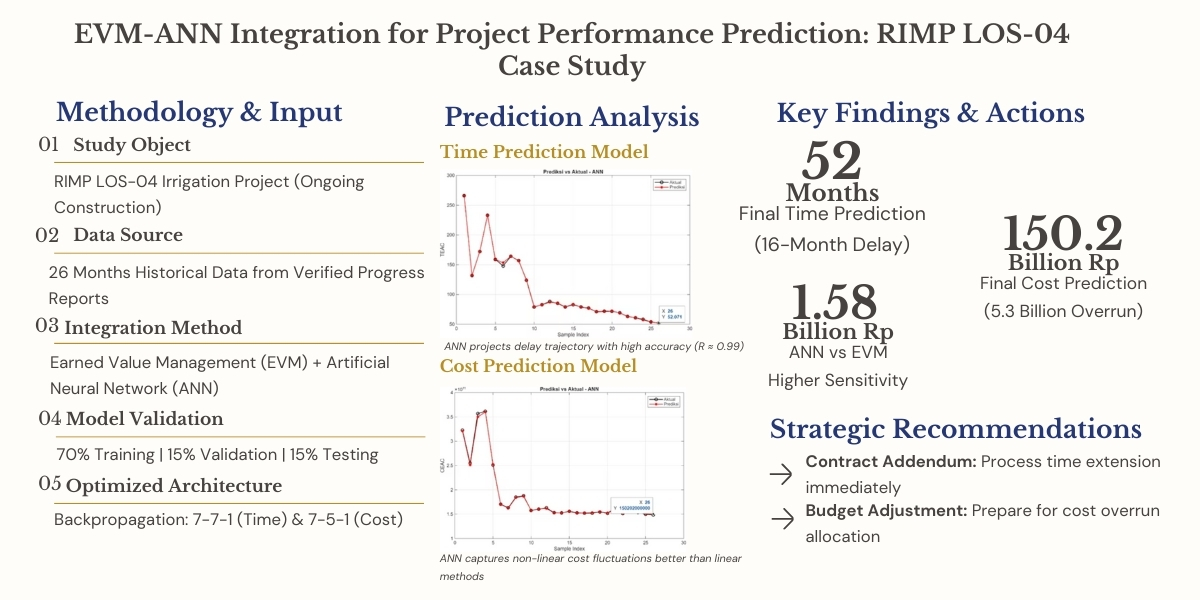
The LOS-04 project, a tertiary irrigation work package of the Rentang Irrigation Modernization Project (RIMP), has been ongoing for 26 months with a physical progress of 60.95%. This study aims to analyze project performance and predict the final cost and completion time by integrating Earned Value Management (EVM) with Artificial Neural Network (ANN). The EVM analysis revealed a Cost Performance Index (CPI) of 0.975 and a Schedule Performance Index (SPI) of 0.687, indicating that the project is experiencing cost overruns and significant schedule delays. To improve forecasting accuracy, an ANN model was developed using historical project data. The integration of EVM and ANN predicts a final project cost of Rp. 150.2 billion and a total duration of 52 months. These findings provide critical insights for project monitoring and evaluation, allowing stakeholders to formulate necessary corrective actions to mitigate further risks.
Conclusion
Based on the project performance analysis and the predictive modeling conducted using the 26-month dataset, the following conclusions are drawn:
(1) Based on the analysis up to the 26th month, the project is experiencing significant deviations from the baseline plan. The physical realization only reached 60.95% against the target of 88.73%. This delay is quantified by the Schedule Performance Index (SPI) of 0.69, indicating poor time performance, and a Cost Performance Index (CPI) of 0.97, indicating mild cost inefficiency.
(2) Despite the constraints of limited data characteristic of an ongoing project, the ANN model demonstrated high reliability. The validation process yielded a correlation coefficient (R) of approximately 0.99 with low RMSE values, confirming that the model effectively captures performance patterns without overfitting.
(3) Both the ANN model and standard EVM method predict a critical delay, estimating the total duration to reach 52 months (a 16-month delay). However, regarding costs, the ANN model proves to be more sensitive to risk. While the standard EVM projected a final cost of Rp 148.6 Billion, the ANN estimated a higher requirement of Rp 150.2 Billion. This difference highlights the ANN's capability to provide a more realistic "early warning" by capturing non-linear cost fluctuations that linear EVM calculations might miss.
(4) Based on these findings, corrective measures are urgently needed. It is recommended that stakeholders process a contract addendum for a 16-month extension and prepare a budget adjustment of approximately Rp 5.3 Billion to prevent further cost overruns.
References
[1]
I. Soeharto, MANAJEMEN PROYEK (Dari Konseptual Sampai Opersional). Penerbit Erlangga, 1999.
[2]
N. N. Rodhi, “Perencanaan Manajemen Proyek Dalam Meningkatkan Efektifitas Kinerja Sumber Daya Manusia Di Bojonegoro,” 2024.
[3]
S. Stringer, J. Jusmidah, M. Fikri, and N. Nurhidayah, “Analisis Persepsi Penerapan Manajemen Proyek Terhadap Keberhasilan Suatu Proyek Konstruksi, <em>” Jurnal Ilmiah Ecosystem</em>, vol. 25, no. 1, pp. 185–195, Apr. 2025, doi
https://doi.org/10.35965/eco.v25i1.5869
[4]
W. I. Ervianto, Manajemen Proyek Konstruksi, Revisi. Yogyakarta: Penerbit ANDI, 2019.
[5]
H. Tukundane and Y. Yang, “Effect of Project Control Practices on the Performance of Building Construction Companies in Uganda: A Case Study of the City of Kampala,” Buildings, vol. 14, no. 6, Jun. 2024, doi
https://doi.org/10.3390/buildings14061818
[6]
O. : Suvriati, V. Merdana, and S. Fauziah, “PT. Media Akademik Publisher Optimalisasi Peran Project Administration Dalam Pengelolaan Data Lpj Proyek Di PT. PLN Nusantara Power Services,” JMA), vol. 3, no. 1, pp. 3031–5220, 2025, doi: 10.62281.
[7]
F. Sinurat and F. Misdalena, “Analisis Manajemen Proyek Dengan Metode Critical Path Method (CPM) Pada Proyek Pembangunan Gedung Chandra Tanjung Karang,” Jurnal Konstruksi, vol. 22, no. 2, pp. 98–107, Dec. 2024, doi
https://doi.org/10.33364/konstruksi/v.22-2.2131
[8]
D. Agus Winarto, A. Ratnaningsih, and W. Soetjipto, “Analysis of Project Performance and Completion Time Using Evm and Cpm-Pert Methods (Case Study of Road Reconstruction Project), <em>” International Journal of Sciences: Basic and Applied Research (IJSBAR) International Journal of Sciences: Basic and Applied Research</em>, vol. 70, no. 1, pp. 269–280, 2023, [Online]. Available: https://gssrr.org/index.php/JournalOfBasicAndApplied/index
[9]
W. Xu, “Application of Earned Value Method in Project Cost Management and Schedule Management,” vol. 4, no. 4, 2021, [Online]. Available: http://ojs.bbwpublisher.com/index.php/PBES
[10]
R. Muchammad and B. Wicaksono, “Akselerasi: Jurnal Ilmiah Teknik Sipil Analisis Kinerja Biaya Dan Waktu Menggunakan Metode Earned Value Pada Proyek Pembangunan Infrastruktur Laboratorium Tradisional Food GMP Facility (Paket 3),” vol. 3, no. 1, 2021.
[11]
F. Susilowati and W. M. Kurniaji, “Effective Performance Evaluation to Estimate Cost and Time Using Earned Value, <em>” in IOP Conference Series: Materials Science and Engineering</em>, Institute of Physics Publishing, Mar. 2020. doi
https://doi.org/10.1088/1757-899X/771/1/012055
[12]
Z. R. Kamandang, N. Dita, P. Putra, and A. R. Nauli, “A Guideline of Earned Value Method (EVM) Implementation as Decision Baseline on Acceleration Solutions for Construction Project Scheduling,” 2023. [Online]. Available: www.techniumscience.com
[13]
A. I. Sakti et al., “Implementasi Artificial Neural Network (ANN) dalam Memprediksi Nilai Tukar Rupiah terhadap Dolar Amerika,” Euler : Jurnal Ilmiah Matematika, Sains dan Teknologi, vol. 12, no. 2, pp. 124–130, Nov. 2024, doi
https://doi.org/10.37905/euler.v12i2.26654
[14]
G. Yalçın, S. Bayram, and H. Çıtakoğlu, “Evaluation of Earned Value Management-Based Cost Estimation via Machine Learning,” Buildings, vol. 14, no. 12, Nov. 2024, doi
https://doi.org/10.3390/buildings14123772
[15]
K. S. Al-Gahtani, A. M. Alsugair, N. M. Alsanabani, A. A. Alabduljabbar, and A. S. Almohsen, “ANN prediction model of final construction cost at an early stage, <em>” Journal of Asian Architecture and Building Engineering</em>, vol. 24, no. 2, pp. 775–799, 2025, doi
https://doi.org/10.1080/13467581.2023.2294883
[16]
H. Al-Attar, G. Sweis, B. Tarawneh, W. Abu-Khader, L. Haddad, and R. Sweis, “Enhanced Construction Project Duration Estimation Using Artificial Neural Networks: Initial Design and Planning Stages,” Construction Economics and Building, vol. 25, no. 2, pp. 168–91, Jul. 2025, doi: https://doi.org/
https://doi.org/10.5130/AJCEB.v25i2.9253
[17]
Trijeti, R. Irwanto, T. Rahayu, and A. T. Panudju, “Artificial Neural Networks for Construction Project Cost and Duration Estimation,” Revue d’Intelligence Artificielle, vol. 37, no. 6, pp. 1449–1460, Dec. 2023, doi
https://doi.org/10.18280/ria.370609
[18]
S. Setiyono, A. M. Hajji, A. Larasati, and I. Alfianto, “Simulasi Progres Proyek Konstruksi Time Performance Menggunakan Earned Value Management dengan Integrasi Artificial Neural Network,” Bentang : Jurnal Teoritis dan Terapan Bidang Rekayasa Sipil, vol. 12, no. 1, pp. 37–48, Jan. 2024, doi
https://doi.org/10.33558/bentang.v12i1.7296
[19]
J. W. Soetjipto, A. Ratnaningsih, S. Arifin, D. A. Adinanda, and K. H. Wicaksono, “Improving the effectiveness of project scheduling by using Earned Value Management and Artificial Neural Network,” Revista Ingenieria de Construccion, vol. 39, no. 2, pp. 161–173, 2024, doi
https://doi.org/10.7764/RIC.00112.21
[20]
P. Urgilés, J. Claver, and M. A. Sebastián, “Analysis of the earned value management and earned schedule techniques in complex hydroelectric power production projects: Cost and time forecast,” Complexity, vol. 2019, 2019, doi
https://doi.org/10.1155/2019/3190830
[21]
The standard for project management and a guide to the project management body of knowledge (PMBOK guide). Project Management Institute, Inc., 2021.
[22]
H. Muharam and ; Muhammad Panji, “Multifraktalitas Dan Studi Komparatif Prediksi Indeks Dengan Metode Arima Dan Artificial Neural Network (ANN),” 2008.
[23]
R. H. Dananjaya, S. Sutrisno, and S. Fitriady, “Penerapan Artificial Neural Network (ANN) Dalam Memprediksi Kapasitas Dukung Fondasi Tiang,” Matriks Teknik Sipil, vol. 10, no. 4, p. 419, Dec. 2022, doi
https://doi.org/10.20961/mateksi.v10i4.65034
[24]
G. Bin Huang, “Learning capability and storage capacity of two-hidden-layer feedforward networks,” IEEE Trans Neural Netw, vol. 14, no. 2, pp. 274–281, Mar. 2003, doi
https://doi.org/10.1109/TNN.2003.809401
[25]
K. G. Sheela and S. N. Deepa, <em>“Review on methods to fix number of hidden neurons in neural networks</em>,” Math Probl Eng, vol. 2013, 2013, doi
https://doi.org/10.1155/2013/425740
[26]
R. Ryandhi, “Penerapan Metode Artificial Neural Network (ANN) Untuk Peramalan Inflasi Di Indonesia Application Of Artificial Neural Network (ANN) For Inflation Forecasting In Indonesia,” ITS, 2017.
[27]
R. K. Challa and K. S. Rao, “An Effective Optimization of Time and Cost Estimation for Prefabrication Construction Management Using Artificial Neural Networks,” Revue d’Intelligence Artificielle, vol. 36, no. 1, pp. 115–123, Feb. 2022, doi
https://doi.org/10.18280/ria.360113
[28]
Y. Zhou, Y. Xu, X. Rao, Y. Hu, D. Liu, and H. Zhao, “Artificial Neural Network-(ANN-) Based Proxy Model for Fast Performances’ Forecast and Inverse Schedule Design of Steam-Flooding Reservoirs,” Math Probl Eng, vol. 2021, 2021, doi
https://doi.org/10.1155/2021/5527259